
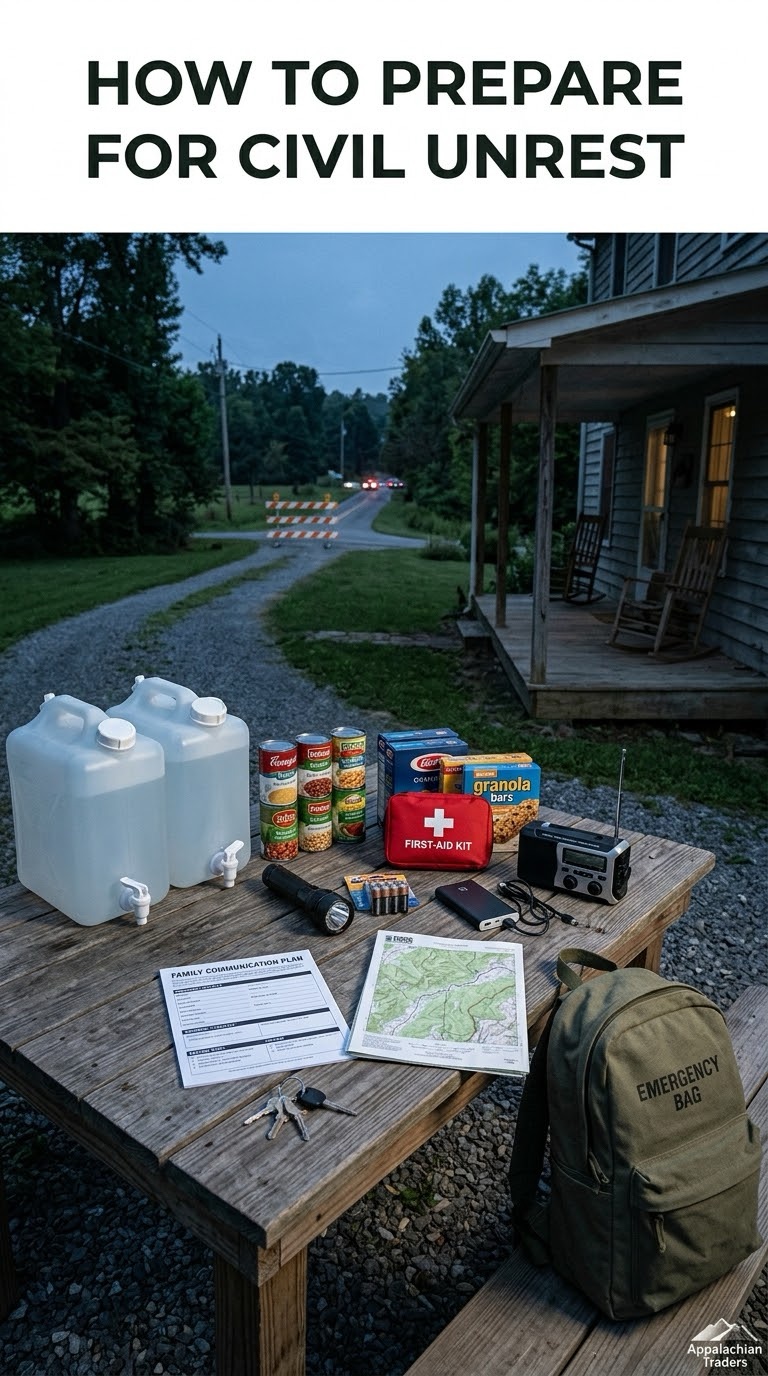
Civil unrest can happen for many different reasons, and you don’t have to take a political side to prepare for the possibility of disruptions in your community.
For preparedness-minded families, the goal isn’t to become part of the situation. It’s to stay safe, avoid unnecessary conflict, and make sure your household can take care of itself if normal services are disrupted.
Civil unrest can bring temporary problems such as road closures, disrupted transportation, crowded stores, power interruptions, communication problems, or difficulty accessing certain areas.
The best time to prepare is before those problems happen.
1. Stay Informed
One of the most important parts of preparedness is knowing what’s happening around you.
Keep up with reliable local information through:
- Local emergency alerts
- Local government announcements
- Emergency management agencies
- Trusted local news sources
- Weather alerts
- Official law-enforcement notifications when appropriate
Avoid relying entirely on social media posts or rumors. During a rapidly developing event, inaccurate information can spread quickly.
If something is happening nearby, knowing about it early can give your family more time to make a safe decision.
2. Have a Plan to Stay Home
If conditions outside become unsafe, staying home may be the safest option.
Think through what your household would need if you couldn’t make a normal trip to the store for several days.
A basic household emergency supply should include:
- Drinking water
- Shelf-stable food
- Prescription medications and necessary medical supplies
- First-aid supplies
- Flashlights
- Extra batteries
- Portable power banks
- Battery-powered or hand-crank radio
- Hygiene supplies
- Toilet paper
- Basic cleaning supplies
- Pet food and pet supplies if applicable
You don’t need to buy everything at once. Build your supplies gradually and focus on items your household already uses.
3. Secure Your Home
Home security during civil unrest is primarily about prevention and avoidance.
Make sure exterior doors have functioning locks and that windows can be secured. Keep outside areas reasonably well maintained so you can see what’s happening around your property.
At night, exterior lighting can also help you identify activity around your home.
Don’t advertise that you have large amounts of supplies. Preparedness should be practical and discreet.
The objective isn’t to confront anyone. It’s to make your home a place where your family can safely shelter while avoiding unnecessary interaction with people outside.
4. Keep Your Vehicle Ready
Transportation can become difficult when roads are blocked, businesses close, or fuel becomes harder to obtain.
Keep your vehicle maintained and avoid letting the fuel level get unnecessarily low.
Consider keeping an emergency vehicle kit containing:
- Phone charger
- Jumper cables
- Flashlight
- First-aid kit
- Bottled water
- Basic tools
- Work gloves
- Blankets
- Emergency contact information
- Tire-inflation equipment
Know several routes to important locations such as home, work, medical facilities, and the homes of close family members.
Don’t drive toward an area simply to see what’s happening.
5. Create a Family Communication Plan
Your family should know what to do if normal communication becomes difficult.
Choose an out-of-area contact who can serve as a central point of communication if appropriate.
Write down important phone numbers rather than keeping them only in your phone.
Your plan should answer simple questions:
Where do we meet?
Who contacts whom?
What happens if someone can’t get home?
Where do we go if we are told to evacuate?
How will we communicate if cell service becomes unreliable?
Keep a printed copy of your plan with your emergency supplies.
6. Have an Evacuation Plan
Preparedness isn’t only about staying home.
Sometimes authorities may recommend or order an evacuation, or conditions may make leaving the safest option.
Know multiple ways out of your immediate area and identify possible destinations ahead of time.
Keep important documents, medications, identification, chargers, water, and basic supplies where they can be gathered quickly.
If you are instructed to evacuate, don’t wait until roads become heavily congested if you can safely leave earlier.
Follow official instructions and avoid traveling through areas where unrest is occurring.
7. Avoid Confrontation
This is one of the most important rules.
If you encounter a demonstration, confrontation, large crowd, or area experiencing violence, don’t get involved just because you are curious.
Turn around and find another route.
Don’t argue with strangers.
Don’t attempt to intervene in confrontations that don’t involve you.
Don’t enter restricted areas.
Don’t assume a situation is safe simply because it appears calm from a distance.
Your supplies aren’t worth putting yourself or your family in unnecessary danger.
8. Prepare for Temporary Utility Disruptions
Civil unrest isn’t necessarily going to cause a power outage, but preparedness for one makes sense regardless.
Keep flashlights somewhere everyone can find them.
Have backup batteries and charged power banks available.
A battery-powered or hand-crank radio can provide another way to receive information.
If the power goes out, remember that refrigeration and food safety become concerns. Have shelf-stable foods available so you aren’t completely dependent on your refrigerator or freezer.
Water is even more important.
A reasonable emergency water supply should be part of every household’s preparedness plan.
9. Protect Important Documents
Keep copies of important documents in a secure location.
Depending on your household, these may include:
- Identification
- Insurance information
- Medical information
- Prescription information
- Emergency contacts
- Vehicle information
- Property records
- Important phone numbers
Consider keeping protected digital copies as well as physical copies.
If you need to leave quickly, having this information organized can make a stressful situation easier to manage.
10. Don’t Forget Your Medical Needs
Medical preparedness is often overlooked.
Make sure your household knows where necessary medications and medical supplies are kept.
Maintain an appropriate supply of routine medications according to your doctor’s instructions and prescription availability.
A basic first-aid kit should also be accessible.
For more serious injuries or medical emergencies, seek professional medical care whenever possible. Emergency preparedness isn’t a replacement for doctors, hospitals, or emergency services.
11. Prepare Your Pets
Pets need a plan too.
Keep food, water, medications, leashes, carriers, and other necessities available.
Make sure identification information is current.
If you have to evacuate, don’t assume every shelter or hotel will accept animals. Identify pet-friendly options ahead of time.
A few minutes of planning can make evacuation much easier.
12. Use Common Sense With Social Media
During a crisis, social media can provide useful information—but it can also spread rumors quickly.
Before sharing something, ask:
- Where did this information come from?
- Is the source reliable?
- Is the information current?
- Is there another reliable source confirming it?
Avoid posting information that could put your household or other people at risk.
During an active emergency, your priority should be safety, not being the first person to post an update.
13. Build Your Supplies Before You Need Them
You don’t need a giant stockpile.
Start with the basics and build from there.
For example, you might begin by adding an extra package of shelf-stable food during your normal grocery trip. Next time, add batteries or a flashlight. Then add water storage or first-aid supplies.
Preparedness doesn’t have to be expensive.
The goal is to gradually create a household that can handle temporary disruptions without immediately becoming dependent on outside assistance.
A Simple 72-Hour Preparedness Checklist
If you’re starting from scratch, concentrate on these basics first:
Water
- Drinking water
- Water containers
Food
- Shelf-stable meals
- Snacks
- Manual can opener
Lighting
- Flashlights
- Batteries
- Lantern
Communication
- Charged phone
- Power bank
- Emergency radio
Medical
- First-aid kit
- Necessary medications
- Basic personal medical supplies
Hygiene
- Toilet paper
- Soap
- Hand sanitizer
- Personal hygiene items
Transportation
- Fuel
- Vehicle emergency kit
- Paper map
Family
- Emergency contacts
- Meeting location
- Evacuation plan
Pets
- Food
- Water
- Medications
- Leash/carrier
Preparedness Is About Staying Out of Trouble
Preparing for civil unrest doesn’t mean expecting the worst or assuming violence is inevitable.
It’s about recognizing that communities can experience temporary disruptions and making sure your household has options.
A family with food, water, basic medical supplies, communication methods, transportation plans, and an evacuation plan has more flexibility when something unexpected happens.
Most importantly, don’t go looking for trouble.
Stay informed.
Stay calm.
Avoid dangerous areas.
Follow lawful emergency instructions.
Take care of your household.
And remember that preparedness is most useful when it helps you avoid a crisis rather than become part of one.
Appalachian Traders
At Appalachian Traders, our approach to preparedness is simple: learn useful skills, keep practical supplies on hand, make a plan, and don’t let fear make your decisions for you.
You don’t need to prepare for everything at once.
Start with what you can afford, learn as you go, and build a household that is a little more capable every day.
 Appalachian Traders
Leave a comment