
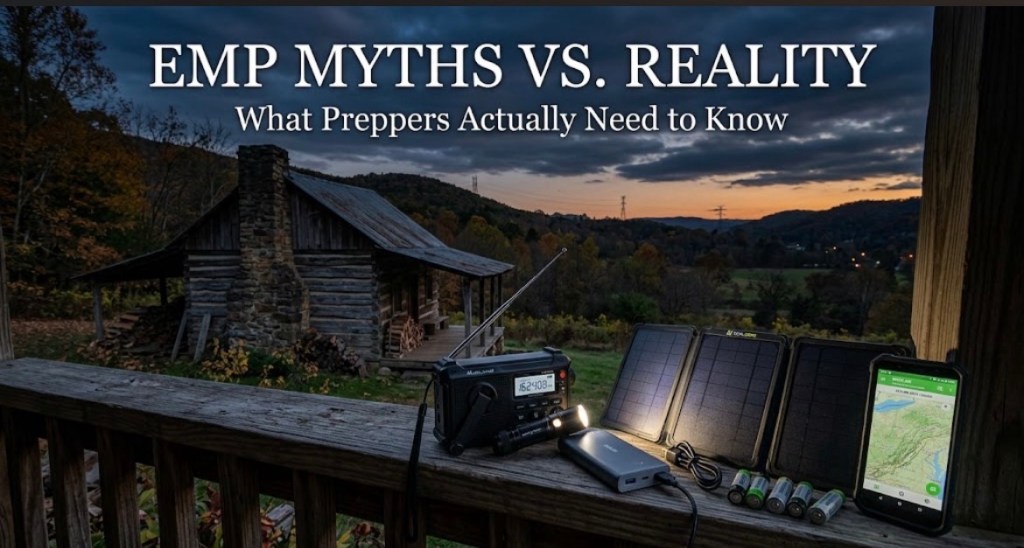
EMP is one of those subjects that gets talked about constantly in the preparedness community.
You’ll hear claims that an EMP would instantly destroy every electronic device in the country, shut down every vehicle, and send society back to the Stone Age overnight.
Some of those concerns have a basis in reality.
Some don’t.
For Appalachian Traders, preparedness means separating the two.
What Is an EMP?
An electromagnetic pulse, or EMP, is a burst of electromagnetic energy that can interfere with or damage electronic equipment and electrical infrastructure.
A high-altitude nuclear detonation can produce a large-area EMP. Natural events can also create electromagnetic disturbances. One important example is a geomagnetic disturbance caused by major solar activity.
The federal government takes these risks seriously. The Department of Energy and CISA have programs specifically focused on understanding EMP and geomagnetic-disturbance risks to critical infrastructure.
But that doesn’t mean every electronic device would automatically stop working.
Myth 1: “An EMP would instantly destroy every electronic device.”
Reality: Not necessarily.
The effects depend on the strength and characteristics of the electromagnetic disturbance, the equipment involved, its location, and how it is connected to conductive infrastructure.
Long wires, power lines, antennas and other conductors can act as pathways for induced electrical currents.
CISA notes that EMP effects can include damage to unprotected electronics and adverse effects on portions of the electric grid.
That is very different from saying every phone, flashlight, vehicle and calculator would instantly become useless.
Myth 2: “Your car will definitely stop running.”
Reality: There is no simple yes-or-no answer.
Modern vehicles contain plenty of electronics, but vehicles vary considerably in design, shielding and susceptibility.
A blanket statement that every modern vehicle would immediately shut down isn’t supported by the available evidence.
That’s why a better preparedness strategy is to avoid depending entirely on any single technology.
Keep basic transportation options available, maintain your vehicle, and have supplies that don’t require electricity.
Myth 3: “A solar storm and a nuclear EMP are basically the same thing.”
Reality: They are different phenomena.
A high-altitude EMP is produced by a nuclear detonation.
A geomagnetic disturbance can result from major solar activity. These disturbances interact with Earth’s magnetic field and can induce currents in long conductors such as power-transmission systems.
DOE explains that severe geomagnetic disturbances can affect the electric grid and other electrical and electronic systems.
The distinction matters because the mechanisms and vulnerabilities aren’t identical.
Myth 4: “A Faraday cage makes everything completely EMP-proof.”
Reality: Protection depends on how the enclosure is designed and used.
A conductive enclosure can reduce electromagnetic exposure, but simply putting something inside a metal container doesn’t automatically guarantee protection.
Gaps, seams, cables entering the enclosure and other conductive paths can affect how well a system is protected.
CISA identifies Faraday cages and other passive mitigation methods among technologies used for electromagnetic protection.
For the average household, the goal shouldn’t be building a perfect military-grade bunker.
It’s having a reasonable backup for important electronics.
Myth 5: “You need to spend thousands of dollars preparing for an EMP.”
Reality: You can build resilience without going broke.
This is where practical preparedness makes the most sense.
Instead of buying expensive EMP gadgets, consider protecting or maintaining things that would actually be useful during a prolonged power outage:
● Battery-powered radios
● Flashlights
● Rechargeable batteries
● Backup power banks
● Solar charging equipment
● Printed maps
● Paper copies of important information
● Basic hand tools
● Emergency lighting
● A small collection of spare electronics
● Important information stored offline
And don’t forget the basics.
Water, food, sanitation, medical supplies, cooking methods and alternative lighting are useful during many emergencies—not just an EMP.
Myth 6: “If the grid goes down, nothing can be done.”
Reality: Preparedness is about reducing dependence.
You don’t need to predict exactly what caused an outage to prepare for one.
A major storm, cyberattack, equipment failure, wildfire, ice storm, geomagnetic disturbance or other event could interrupt electricity or communications.
The same preparedness measures can help with all of them.
That’s the better way to think about EMP preparedness.
Don’t prepare for one Hollywood scenario.
Prepare for loss of essential services.
What Should You Actually Do?
Start simple.
1. Have backup lighting
Keep several reliable flashlights and lanterns available.
Don’t rely on one device.
2. Store batteries
Keep commonly used battery sizes on hand and rotate them.
Rechargeable batteries are useful, but keep some disposable batteries as a backup.
3. Have a way to receive information
A battery-powered or hand-crank emergency radio can be useful when normal communications are disrupted.
4. Keep important information offline
Don’t assume you’ll always have internet access.
Store important phone numbers, maps, medical information, manuals and other useful information in physical or offline form.
5. Have backup power
A power bank can keep a phone running during a short outage.
For longer outages, solar panels, battery systems or generators can provide additional options.
6. Don’t forget non-electronic skills
This may be the most important part.
Know how to cook without the grid.
Know how to purify water.
Know how to preserve food.
Know basic first aid.
Know how to grow and store food.
Know how to navigate without GPS.
Know how to stay warm and safe without depending completely on modern infrastructure.
Technology is useful.
Skills are harder to take away.
The Bottom Line
An EMP is not a fictional threat. The U.S. government actively studies EMP and geomagnetic-disturbance risks because these events can potentially disrupt technology and critical infrastructure.
But preparedness shouldn’t be built around panic.
You don’t need to throw your electronics in a bunker or spend thousands of dollars on questionable EMP products.
Build redundancy.
Keep backups.
Learn practical skills.
Store information in more than one format.
And prepare for the broader problem: what happens when the power, communications or other essential services aren’t available?
That’s preparedness that makes sense whether an EMP ever happens or not.
Prepare for the outage, not the apocalypse.
 Appalachian Traders
Leave a comment