
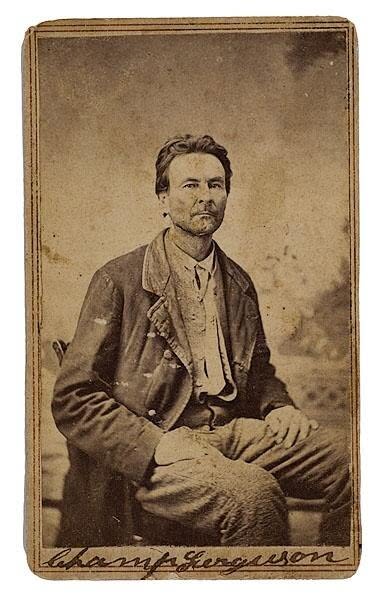
Kentucky Roots
Samuel “Champ” Ferguson was born November 29, 1821, in Clinton County, Kentucky, near the Tennessee border. He grew up in the Kentucky-Tennessee border country, an area where family relationships, local loyalties, political disagreements, and personal feuds could run deep.
That location matters when telling Ferguson’s story.
The Civil War did not simply divide the country into two neat sides. In places like southern Kentucky and East and Middle Tennessee, the conflict could divide neighbors, families, churches, communities and even brothers.
Ferguson’s own family became divided by the war. His brother Jim supported the Union and served as a Union cavalry scout. According to accounts of the period, the two brothers became enemies during the conflict.
This was the world into which Champ Ferguson entered the Civil War.
From Local Feud to Guerrilla War
Before Ferguson became infamous, there were already tensions and personal conflicts surrounding him.
As the war spread into the Kentucky-Tennessee border region, those old disputes became mixed with the much larger political conflict between Unionists and Confederates.
Ferguson eventually operated with Confederate forces but frequently functioned as an independent guerrilla leader rather than a conventional soldier. He was also associated with Confederate cavalry operations and served as a scout connected with John Hunt Morgan.
His opponent on the Union side was another notorious local guerrilla, David “Tinker Dave” Beaty.
Their conflict became almost personal warfare.
Ferguson’s men hunted Unionists and suspected Union sympathizers. Beaty’s men hunted Confederates and suspected Confederate sympathizers. The result was a cycle of ambushes, killings, revenge and retaliation that made portions of the Kentucky-Tennessee border extraordinarily dangerous.
This is one of the most important parts of Ferguson’s story because it shows that the Civil War in Appalachia wasn’t always armies meeting on a battlefield.
Sometimes it was one neighbor hunting another neighbor.
Ferguson and the Upper Cumberland
Ferguson eventually established himself in Tennessee, particularly around the Upper Cumberland region.
The geography helped guerrilla warfare flourish. Mountains, forests, isolated farms and rough roads made it possible for small bands of armed men to move through the countryside, strike their enemies and disappear.
The distinction between soldier, guerrilla, partisan and outlaw could become extremely blurred.
Ferguson claimed that many of the people he killed were legitimate enemies and that he was acting as a Confederate soldier. His later defense depended heavily on that argument.
The federal government saw things very differently.
After the war, Ferguson would be accused of murdering dozens of people who were either Union soldiers or Union sympathizers.
Saltville, Virginia
And this brings us to one of the darkest chapters of Ferguson’s story.
Saltville, Virginia.
Saltville was strategically important during the Civil War because of its salt production. Salt was essential for preserving meat and supporting armies, making the Saltville saltworks an important Confederate resource.
In October 1864, Union forces under Brigadier General Stephen G. Burbridge moved against Saltville with the objective of destroying the saltworks.
The resulting battle on October 2 became known as the First Battle of Saltville.
Approximately 5,200 Union soldiers faced about 2,800 Confederate defenders. The Confederates successfully held their position, and the Union army eventually withdrew.
But what happened after the fighting became even more infamous.
The Saltville Massacre
Among the Union troops participating in the battle were soldiers of the 5th United States Colored Cavalry.
These were Black American soldiers fighting in the United States Army.
During the Union retreat, wounded soldiers were left behind.
According to the National Park Service, Confederate forces subsequently murdered wounded Black soldiers who had been left on the battlefield and in medical facilities. Historians generally estimate that approximately 45 to 50 African American soldiers were killed, although the precise number remains disputed.
The violence did not necessarily end on the battlefield.
Federal surgeon William H. Gardner reported that armed men entered a field hospital and removed wounded Black soldiers before killing them. He later reported that wounded Black soldiers were murdered in their beds at Emory and Henry College Hospital.
This is where Champ Ferguson becomes connected to one of the most infamous atrocities of the Civil War in Southwest Virginia.
Federal authorities later accused Ferguson of participating in the killings.
Ferguson denied responsibility for the specific Saltville murders in his final statement.
That distinction is important.
A serious historical article shouldn’t simply say, “Ferguson killed 50 Black soldiers at Saltville.” The historical record is more complicated.
There is strong evidence that wounded Black Union soldiers were murdered by Confederate forces at Saltville, and federal authorities connected Ferguson to the violence. But Ferguson himself denied killing the specific group of twelve soldiers referenced in his indictment, claiming other Confederate commands were responsible.
The U.S. National Park Service identifies Ferguson as one of the perpetrators who was subsequently tried for his involvement in the massacre.
That disagreement is part of the history.
Why Saltville Matters
The Saltville killings weren’t simply another episode of Civil War combat.
These men were wounded.
Some were helpless.
Some were in medical facilities.
And they were Black soldiers serving in the United States Army.
The violence therefore has to be understood within the larger history of Confederate resistance to Black military service and emancipation.
The National Park Service places Saltville alongside other Civil War atrocities involving African American troops, including Fort Pillow, Poison Spring and the Crater.
For Ferguson, however, Saltville was only one part of the accusations that would eventually be brought against him.
The War Ends — But Ferguson’s War Doesn’t
When Confederate armies surrendered in 1865, Ferguson returned home.
But the federal government had not forgotten him.
He was eventually arrested and taken to Nashville.
His trial began in July 1865 before a military commission.
The government accused him of numerous murders.
The indictment involved 53 people, according to surviving trial records.
The prosecution presented witness after witness describing killings allegedly committed by Ferguson and his men.
Among those cases were murders involving people from the Kentucky-Tennessee border region.
Some witnesses had known Ferguson personally.
Others described encounters with his guerrilla band.
The trial became a major postwar spectacle.
Ferguson’s Defense
Ferguson’s defense rested largely on the argument that he had been fighting a war.
He acknowledged killing people.
But he argued that many of the killings were legitimate acts against enemies.
In his final statement, Ferguson claimed that some people he was accused of killing had actually been killed by other men or had died during legitimate fighting.
He also argued that some witnesses had blamed him for killings committed by other guerrilla groups.
His statement is fascinating because it provides Ferguson’s own version of events.
It doesn’t mean his version should automatically be accepted.
But it gives historians an opportunity to see how Ferguson understood himself.
He didn’t portray himself as a murderer.
He portrayed himself as a Confederate fighter who had operated in an extremely violent war and was being blamed for crimes committed by others.
The Verdict
The military commission found Ferguson guilty.
He was sentenced to death.
On October 20, 1865, Champ Ferguson was hanged in Nashville.
He had been convicted of the murders of dozens of people and became one of the most notorious Confederate guerrillas of the Civil War. The National Park Service identifies him as one of the Confederate figures executed by federal authorities in connection with Civil War crimes.
His death came only months after the Confederate surrender.
The war was officially over.
But Ferguson’s execution demonstrated that the federal government intended to pursue at least some of the men accused of atrocities after the fighting ended.
The Man Behind the Legend
Over the years, Champ Ferguson became larger than life.
Stories circulated about him.
Some accounts portrayed him as a bloodthirsty killer who murdered anyone who crossed him.
Other accounts, particularly those sympathetic to the Confederate cause, portrayed him as a courageous partisan fighter who was unfairly prosecuted by the victorious Union government.
Neither version should simply be accepted without examination.
The reality was probably more complicated.
Ferguson lived in an environment where conventional military rules often broke down. But that does not erase the documented killings associated with his guerrilla operations.
At the same time, his own trial statements show that he disputed particular accusations and believed some victims had been improperly attributed to him.
That’s what makes his story worth studying.
Champ Ferguson’s Legacy
Today, Ferguson’s name remains controversial in Kentucky, Tennessee and Southwest Virginia.
To some, he represents the brutality of Confederate guerrilla warfare.
To others, he became a symbol of Appalachian resistance to Union authority.
But perhaps the most important lesson is not whether Ferguson was a “hero” or a “villain.”
It’s what his story tells us about what happens when a civil war reaches into people’s homes.
The violence doesn’t always stay on battlefields.
It moves into farms.
Churches.
Roads.
Hospitals.
Backyards.
And families.
The story of Champ Ferguson is ultimately a story about an Appalachian region where the Civil War became deeply personal.
Kentucky and Tennessee were not simply places where Union and Confederate armies marched through.
They were places where neighbors fought neighbors and sometimes families fought families.
And Saltville demonstrates just how horrific that kind of war could become.
A good closing line for the blog
Champ Ferguson was hanged in 1865, but the questions surrounding his life never really disappeared. Was he a Confederate soldier, a guerrilla, an outlaw, or some combination of all three? The surviving records make one thing clear: in the mountains and valleys of Kentucky, Tennessee and Southwest Virginia, the Civil War could become something far more personal—and far more brutal—than the battles found in history books.
 Appalachian Traders
Leave a comment