
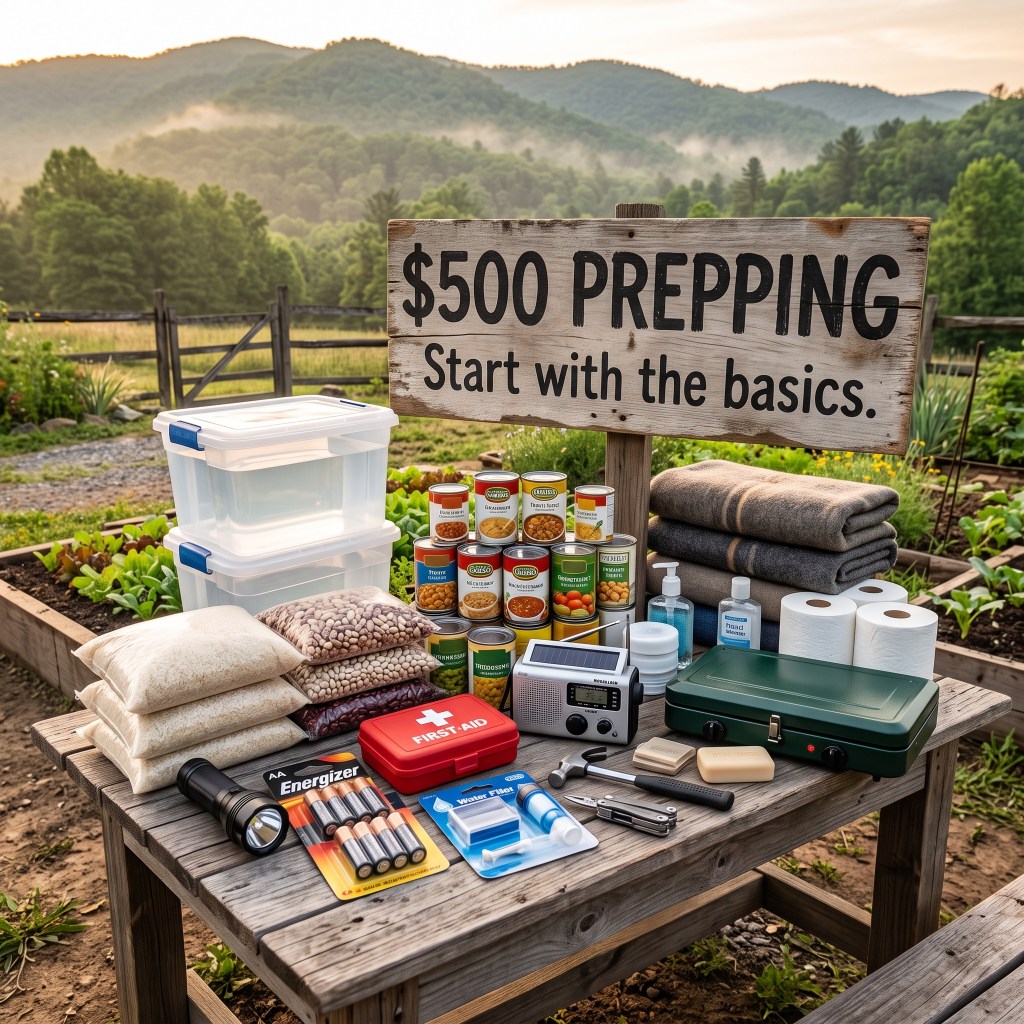
If I had $500 and had absolutely nothing put back for emergencies, I wouldn’t go crazy buying a bunch of tactical gear.
I’d buy the stuff I’m actually going to need.
Because let’s be honest—if the power goes out for three days, I don’t care how cool my gear looks. I need water, food, light, a way to cook, and a way to handle basic problems.
So if I had $500 to start from scratch, this is how I’d spend it.
$75 — Water
Water would be one of the first things I bought.
I’d get some good water containers and start putting water back for emergencies. I’d also look at having a way to filter or treat water if I ever needed it.
You don’t have to build some giant underground bunker.
Just start putting water back.
A few containers today is better than having nothing when the water stops running.
$150 — Food
This is where I’d spend the biggest part of the $500.
But I wouldn’t go buy a bunch of expensive survival food buckets.
I’d buy food I already eat.
Rice. Beans. Pasta. Canned vegetables. Canned meat. Peanut butter. Oatmeal. Cooking oil. Seasonings. Whatever your family actually eats.
The important part is having food that can sit on the shelf for a while and doesn’t require you to run to the grocery store every few days.
And rotate it.
Eat the older stuff and replace it.
That way you’re not wasting money.
$50 — Lights and Batteries
I’ve been in enough situations where you realize how much you depend on electricity.
When the lights go out, you want to know exactly where your flashlight is.
I’d get several flashlights, a couple of lanterns, extra batteries, and maybe a rechargeable light.
Don’t have one flashlight for the entire house.
Put them where you’re actually going to need them.
$50 — First Aid
I’d put another $50 toward a decent first-aid setup.
Nothing fancy.
Bandages, gauze, medical tape, gloves, antiseptic supplies, scissors, cold packs and other basic first-aid items.
You don’t need to be a doctor.
You just need to be able to handle the little stuff while you figure out what you’re doing next.
And check the kit every so often. There’s no point having a first-aid kit if half of it is expired or missing.
$50 — Communication
I’d want an emergency radio and some way to keep my phone charged if the power was out.
A rechargeable power bank is cheap compared with being stuck with a dead phone when you actually need it.
I’d also make sure important phone numbers and information weren’t only stored in my phone.
Technology is great—until the technology isn’t working.
$50 — Cooking
Now you’ve got food.
But how are you going to cook it?
I’d put some money toward an emergency cooking setup and the proper fuel for it.
And this is one area where I’m not taking shortcuts.
Never use a fuel-burning stove, grill, or other appliance indoors unless it’s specifically designed and approved for indoor use.
Carbon monoxide isn’t something you want to mess around with.
$50 — Basic Tools and Supplies
This is probably one of the most useful categories.
I’d get things like:
- Work gloves
- Duct tape
- Rope
- Tarps
- Basic hand tools
- Utility knife
- Buckets
- Zip ties
- Batteries
- Other small supplies that can solve multiple problems
I’m a big believer in buying things that have more than one use.
You don’t need a garage full of expensive equipment to be prepared.
Sometimes a $10 item can solve a $100 problem.
$25 — Storage
Finally, I’d get some heavy-duty storage containers.
There’s no point buying all this stuff and then throwing everything into a pile in the closet.
I’d keep my supplies organized.
One container for food.
One for first aid.
One for emergency equipment.
One for lights and batteries.
When something happens, you don’t want to spend 30 minutes looking for the flashlight.
You want to know exactly where it is.
Here’s the $500 Breakdown
Water — $75
Food — $150
Lights and batteries — $50
First aid — $50
Communication — $50
Cooking — $50
Tools and supplies — $50
Storage — $25
Total — $500
Would I spend exactly $500?
Probably not.
If I found something cheaper, I’d keep the extra money and use it to fill whatever gap I had next.
That’s the whole point.
You Don’t Have to Become a Doomsday Prepper
I’m not talking about building a bunker or preparing for the end of the world.
I’m talking about being able to take care of yourself for a little while when normal life gets interrupted.
A bad storm.
A power outage.
A water problem.
A supply shortage.
A job situation that puts you in a financial bind.
You don’t know what’s going to happen.
But you can control how prepared you are.
Start with $20. Start with $50. Start with whatever you can afford.
You don’t have to buy everything at once.
Just start putting things back.
Because when you need it, it’s too late to wish you had started yesterday.
That’s what prepping is to me.
Not fear.
Just being ready.
How I’d Break Down the $500
| Category | Budget |
|---|---|
| 💧 Water storage & purification | $75 |
| 🥫 Shelf-stable food | $150 |
| 🔦 Lighting & batteries | $50 |
| 🩹 First-aid supplies | $50 |
| 📻 Emergency communication | $50 |
| 🍳 Emergency cooking supplies | $50 |
| 🧰 Basic tools & supplies | $50 |
| 📦 Storage containers | $25 |
| Total | $500 |


Leave a Reply