
Pine pitch is one of the most useful natural substances found in the forest. Long before modern glue, waterproof sealants, fire starters, and manufactured chemicals existed, people learned that pine trees produced a remarkable sticky material that could be collected and put to work. For generations, pine resin and the products made from it have been used for everything from starting fires and attaching tools to waterproofing containers and protecting wooden ships. Even today, learning about pine pitch gives us a glimpse into how people once depended on the natural world for many everyday necessities.
What Is Pine Pitch?
Pine pitch begins with pine resin. Although people often call the sticky material coming from a pine tree “sap,” resin and sap are actually different substances.
Sap moves water, sugars, and nutrients throughout a tree. Resin is part of the pine tree’s defense system. Pine trees contain specialized resin canals. When the tree is damaged by a broken branch, insects, storms, or another injury, resin can flow into the damaged area.
The resin helps protect the wound and acts as a barrier against insects and other threats.
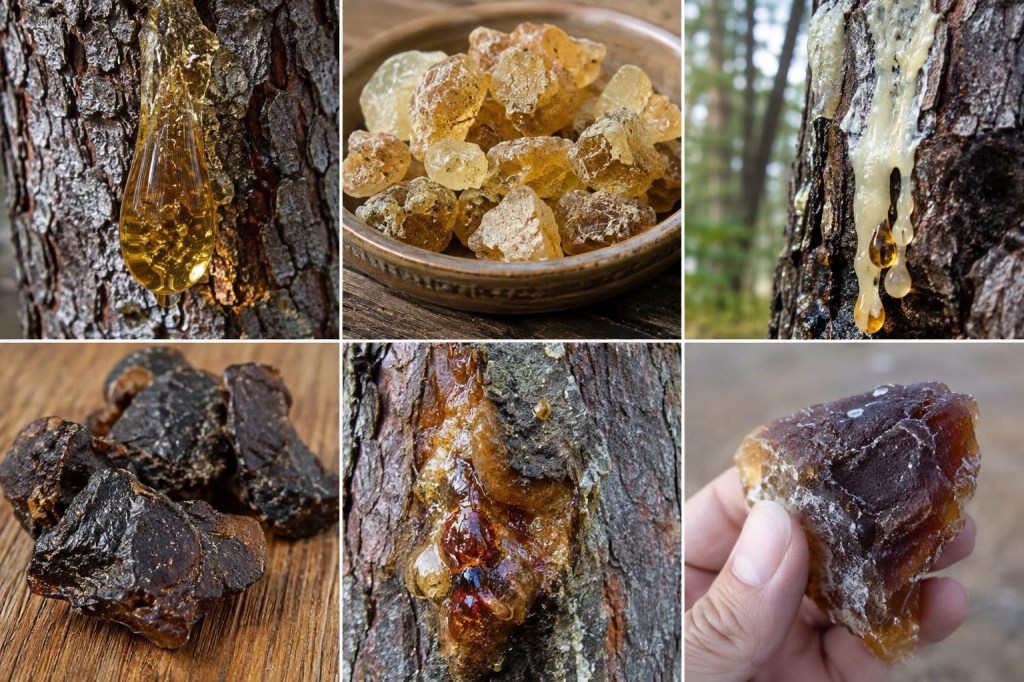
Fresh pine resin can be extremely sticky and may appear clear, golden, amber, yellow, or cloudy white. As it is exposed to the air, some of its volatile compounds evaporate and the resin gradually becomes thicker and harder.
This is why you may find both soft, sticky resin and hard chunks of old resin on the same pine tree.
Strictly speaking, resin, rosin, tar, and pitch are not exactly the same thing, although the terms are sometimes used loosely. Pine oleoresin can be distilled to separate volatile turpentine from solid rosin. Pitch-like materials can also be produced by heating and processing resinous pine material.
Where Can Pine Resin Be Found?
The first requirement is obviously pine trees.
Pines grow throughout large portions of North America and many other parts of the world. Different pine species produce resin, so you do not necessarily need one particular species to begin looking.
Once you locate a pine tree, examine the trunk and larger branches.
Look especially closely at places where the tree has already been damaged. You might find resin around an old broken limb, damaged bark, an insect injury, or another natural wound.
It can look like golden droplets frozen against the bark. Older deposits may be hard, cloudy, yellow, orange, amber, brown, or nearly white.
Sometimes there will only be a small amount. Other times an injured tree can have large deposits running down its trunk.
However, excessive resin can also be a sign that the tree is responding to injury, insects, or disease. Resin is part of the tree’s defense system, so finding a large amount does not necessarily mean the tree is healthy.
How Do You Collect It?
There are historical methods of deliberately tapping pine trees for resin. In the naval-stores industry, workers intentionally wounded trees and placed containers beneath the wounds so the flowing oleoresin could be collected.
For personal use, however, deliberately cutting into a healthy tree usually isn’t necessary.
A much less destructive method is simply looking for trees that have already produced resin around natural wounds.
Loose hardened pieces can sometimes be carefully removed. Softer resin can be scraped into a metal container using an appropriate tool.
There is an important principle to remember:
The resin belongs to the tree’s defense system first.
Avoid stripping healthy bark or cutting deeply into a living tree merely to force it to produce resin. Take small amounts from existing deposits whenever possible.
You should also make sure collecting natural materials is permitted wherever you are. A tree growing on someone else’s land, in a park, or on other public property should never automatically be considered free for harvesting.
Cleaning Pine Resin
Wild pine resin isn’t going to look like something purchased from a store.
It commonly contains pieces of bark, pine needles, dirt, insects, and other debris.
For certain traditional craft purposes, resin can be gently heated until it becomes fluid enough to strain out larger contaminants. After cooling, the cleaned resin hardens again and can be stored.
This process requires caution.
Pine resin is combustible, and heating it can release flammable vapors. Molten resin can also cause severe burns because the sticky material can remain against the skin.
It should therefore never be carelessly melted over an open flame or left unattended while heating.
Pine Pitch as Natural Glue
One of the most fascinating traditional uses of pine pitch is making adhesive.
Imagine living hundreds or thousands of years ago. You need to fasten a stone point to a wooden shaft, repair an object, or attach two materials together.
There is no super glue.
There is no epoxy.
But there are pine trees.
People discovered that resinous materials could be heated and used as an adhesive. Traditional pitch glues could also incorporate finely powdered materials such as charcoal or ash to modify the adhesive’s properties.
This type of technology demonstrates something important about early survival skills. People weren’t simply surviving in nature. They understood the properties of natural materials well enough to transform them into useful technologies.
Pine pitch was essentially part of nature’s hardware store.
Waterproofing and Sealing
Another major advantage of pine-derived pitch is its resistance to water.
Resinous materials have historically been used to protect wood, seal containers, waterproof certain traditional objects, and help keep water from penetrating seams.
This became particularly important in wooden shipbuilding.
Before modern synthetic sealants existed, keeping a wooden vessel watertight was a constant challenge. Tar, pitch, and related resinous products became valuable for protecting wooden surfaces and sealing parts of ships.
These materials became so important to maritime industries that pine-derived products such as tar, pitch, turpentine, and rosin became associated with the historic naval stores industry.
Something produced by a tree as a defense mechanism eventually helped humans protect ships crossing entire oceans.
Pine Resin and Fire
Another valuable property of pine resin is that it burns readily.
Anyone familiar with resin-rich pine wood, sometimes called fatwood, knows how useful it can be when starting a fire.
Resin-rich material catches fire more readily than ordinary damp or untreated wood and can burn intensely enough to help ignite larger pieces of kindling.
For people traveling or living in the wilderness, this could make pine resin an important fire-making resource.
However, the very thing that makes resin useful for fire also makes it dangerous when mishandled. Resin, resin-rich wood, and concentrated vapors should always be treated as combustible materials.
Torches and Light
Before electricity, darkness presented a much greater challenge than it does today.
People had to create light from whatever resources were available.
Resinous pine materials were useful because they could burn strongly. Pine-rich fuels could therefore contribute to primitive torches and other forms of illumination.
A substance produced to protect a tree could help a human being illuminate the darkness.
Traditional Medicinal Uses
Pine resin also has a long history in traditional and Indigenous practices.
Different peoples used pine materials in preparations associated with wounds, sores, burns, and other conditions. Some pine resin compounds have demonstrated antimicrobial properties, which helps explain why the material attracted attention historically.
However, traditional use and modern medical treatment are not the same thing.
Wild pine resin is not sterile, and some people can experience skin irritation or allergic reactions to resin and rosin. It should not be treated as a substitute for proper medical care, particularly for serious wounds, burns, infections, or illnesses.
Its medicinal history is nevertheless important because it demonstrates just how closely earlier societies studied and utilized the trees surrounding them.
Rosin and Turpentine
Pine resin eventually became much more than a wilderness survival material.
It became an important commercial resource.
When pine oleoresin is distilled, its volatile portion can be collected as turpentine, while the solid material remaining behind is rosin.
Rosin has been used in numerous industrial and practical applications. Musicians may recognize rosin because it is applied to the bows of stringed instruments to create the friction needed between the bow hair and strings.
Rosin and other pine-derived materials have also been used in adhesives, coatings, inks, varnishes, soaps, and numerous industrial products.
Turpentine became especially well known as a solvent and ingredient associated with paints and varnishes.
The humble sticky material found on a pine tree therefore helped support entire industries.
Pine Pitch and the Naval Stores Industry
Pine products became particularly important in the American South.
Forests containing resin-rich pine species supplied raw material for producing tar, pitch, rosin, and turpentine.
These materials were called naval stores because of their importance to wooden sailing ships and maritime industries.
Workers harvested enormous amounts of resin from pine trees. The resin could then be transported and processed into commercially useful materials.
It became an industry built around something most people today might simply walk past without noticing.
The Many Uses of Pine Pitch
Over centuries, pine resin, pitch, rosin, tar, and related pine-derived materials have been associated with an impressive range of applications. They have been used in natural adhesives, traditional tool making, waterproofing, wood protection, shipbuilding, caulking, fire starting, torches, varnishes, paints, rosin, turpentine, traditional medicinal preparations, crafts, and other practical purposes.
Not every pine product is interchangeable. Pine resin, rosin, tar, turpentine, and pitch are different materials produced or processed in different ways. Understanding those differences is part of understanding just how sophisticated traditional pine-product industries became.
The Benefits of Pine Pitch
Perhaps pine pitch’s greatest benefit is its versatility.
One naturally occurring material can provide adhesion, water resistance, combustibility, and a starting material for other useful products.
For someone interested in traditional wilderness skills, pine resin also has another benefit: it teaches resourcefulness.
Instead of asking, “What can I buy to solve this problem?” earlier generations often had to ask, “What does the land around me already provide?”
A pine tree could provide wood for shelter and fire, while its resin could contribute to adhesive, waterproofing, illumination, and other useful materials.
Knowledge transformed an ordinary tree into a collection of resources.
Harvesting With Respect
There is one final lesson that should accompany any discussion of pine pitch.
The tree produces resin for itself—not for us.
Resin is part of the pine’s natural defense against injury and attack. Cutting deeply into a healthy tree simply to obtain a small amount of resin creates the very injury the tree then has to defend.
Whenever possible, collect hardened resin that has already accumulated around existing wounds rather than deliberately damaging healthy trees.
Take only what you need.
Respect private property and harvesting regulations.
And remember that good wilderness knowledge isn’t simply knowing how to take resources from nature. It is knowing how to use those resources responsibly.
Conclusion
Pine pitch represents something much larger than a sticky substance on the side of a tree.
It represents thousands of years of observation, experimentation, and human ingenuity.
People discovered that the resin flowing from an injured pine could become adhesive. They learned that resinous materials resisted water. They discovered that resin-rich wood burned exceptionally well. Eventually, pine products became so valuable that entire industries developed around producing pitch, tar, rosin, and turpentine.
Today we have manufactured adhesives, waterproof sealants, electric lights, synthetic coatings, and countless other conveniences.
Yet the original resource is still growing quietly in the forest.
The next time you walk beneath a stand of pine trees and notice a golden drop hardened against the bark, you are looking at more than tree resin.
You are looking at one of nature’s oldest toolboxes—and a material that humans have been learning how to use for generations.


Leave a Reply