
BY Zach
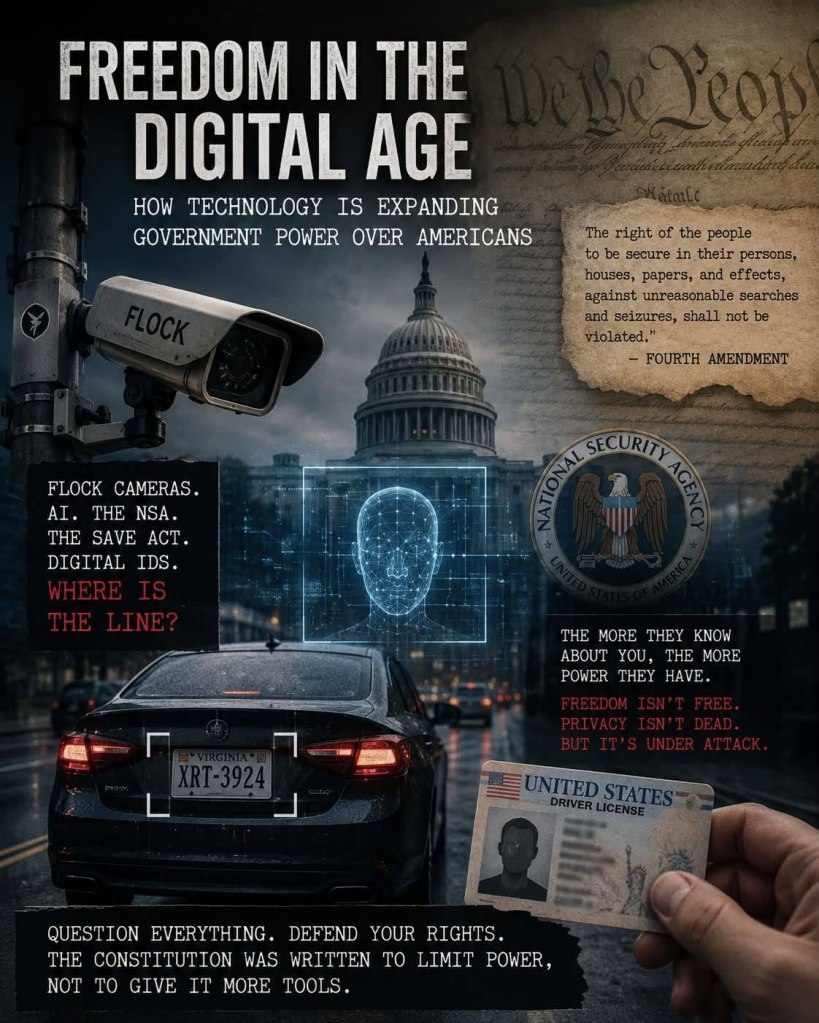
America was built on the idea that the government answers to the people, not the other way around. Every generation has had to fight to protect the freedoms guaranteed by the Constitution. Today, that fight isn’t just about laws—it’s about technology.
We’ve got AI, cameras watching roads, databases storing information, and government agencies with more access to data than ever before. Technology can make life easier and help catch criminals, but it can also give the government more power over everyday Americans.
Take Flock cameras. They sit on poles and scan license plates day and night. If I wasn’t speeding, wasn’t breaking the law, and no officer ever pulled me over, then how does the government know it was me? A camera can identify a vehicle, but it doesn’t automatically identify the driver. That information often has to come from other records or evidence. That’s a question more Americans should be asking.
Then there’s artificial intelligence. AI can pull information together in seconds that would have taken investigators weeks or months years ago. It can connect records, analyze patterns, and make it easier for the government to build a picture of someone’s life. That kind of power deserves serious oversight.
The NSA has also raised questions for years about how much information the government should collect in the name of national security. Most Americans want to be safe, but we also want to stay free. Those two goals should never be treated as if they can’t exist together.
The debate over voter identification and the SAVE Act is another example of how technology and government power intersect. Supporters of the SAVE Act argue that requiring documented proof of U.S. citizenship to register to vote protects election integrity and helps ensure that only citizens vote in federal elections. Critics argue that the proposal could make it harder for some eligible citizens—especially those who have changed their names after marriage or who don’t have easy access to citizenship documents—to register. Whatever side someone takes, it’s a reminder that government identification has become a bigger part of everyday life.
Everywhere we turn, we’re asked for an ID. To fly, to open a bank account, to apply for a job, to buy certain products, and sometimes even to access government services. The more our lives become digital, the more our identity is tied to government records and databases.
I’m not against law enforcement. I’m not against secure elections. I’m not against technology. I’m against the idea that freedom should slowly disappear because every new tool promises more convenience or more security.
The Founding Fathers limited government because they understood one simple truth: power almost always grows if no one questions it. That’s why the Constitution matters just as much today as it did over 200 years ago.
Technology will keep advancing. AI will become smarter. Cameras will become more common. Databases will become larger. The real question is whether our constitutional rights will grow with that technology—or whether they’ll slowly be left behind.
Freedom isn’t lost all at once. Sometimes it’s lost one new system at a time.


Leave a Reply